Valencia City of Arts and Sciences & The Best Paella: A Complete Guide
By Triprz Editorial Team | September 28, 2026
Valencia is the birthplace of paella and home to Europe's most futuristic cultural complex. Here's how to experience both in one trip.
Tags: Valencia, Spain, City of Arts and Sciences, Paella, Travel Guide, 2026
Article
Valencia refuses to be just one thing. Spain's third-largest city, midway along the Mediterranean coast, is at once a Roman settlement, a Moorish medina, a Gothic maritime power, and the laboratory of one of the most futuristic skylines in Europe. Few cities pack such a range into a single walkable footprint — and fewer still can claim to have invented their country's most famous dish.

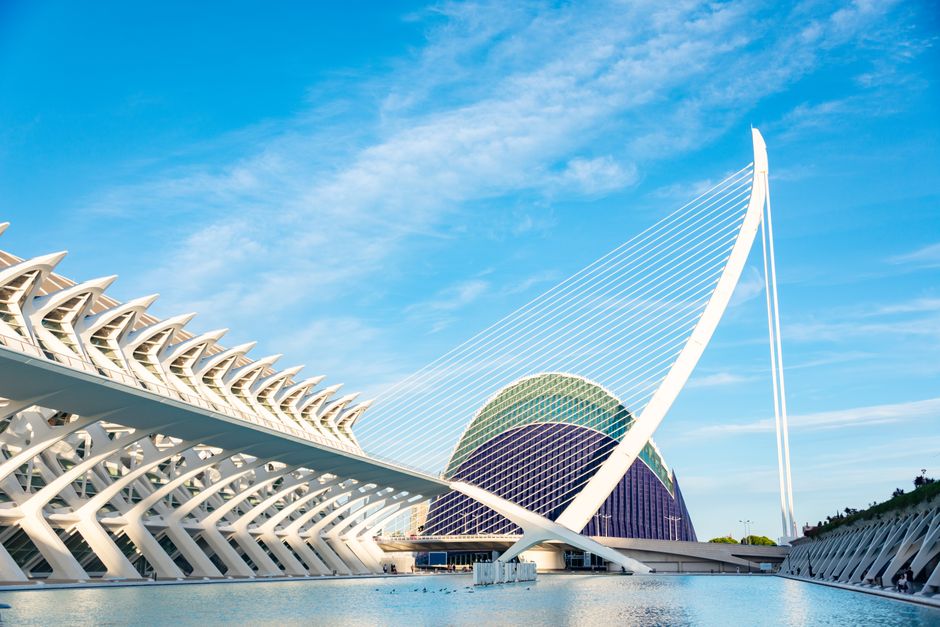
The two headline attractions are halves of a whole. On the eastern edge, across the drained bed of the old Turia, the **City of Arts and Sciences** rises like a fleet of bone-white spacecraft — the masterpiece of Valencian architect Santiago Calatrava and the most photographed complex in Spain outside Barcelona. A few kilometers west, inside the old town, the smell of saffron and woodsmoke drifts from kitchens that have been cooking **paella** since before the dish had a name. Valencia is the birthplace of paella. Eating it here, where the rice is grown and the recipes were written, is not the same as eating it anywhere else.

This guide covers both, plus everything you need for a 2026 trip: ticket prices and hours for every building, where to find authentic paella, the old town, the beaches, a day-by-day itinerary, a month-by-month table, transport, and a full cost breakdown.

---

## The City of Arts and Sciences

### History and Architecture

The City of Arts and Sciences (Ciudad de las Artes y las Ciencias) occupies the eastern stretch of the former Turia riverbed. The river flooded catastrophically in 1957; the authorities diverted it south, leaving a dry trench through Valencia that was mostly neglected for decades. In the 1990s the regional government seized on it as the site for a cultural mega-project.

Santiago Calatrava, born in the Valencia suburb of Benimàmet in 1951, won the commission in 1991. After a change of government in 1996 the brief grew into six major structures arranged along a linear east-west axis, separated by reflecting pools. Félix Candela, the Spanish-Mexican shell-concrete pioneer, contributed the Oceanogràfic's intersecting hyperbolic vaults. Construction began in July 1996; the complex opened in stages over more than a decade, with the final component, L'Àgora, completed in 2009. The total cost came to roughly €1.2 billion — several times the original estimate — and the project remains politically controversial. But architecturally it is one of the most ambitious public works of the era. Calatrava's white concrete, ribs, and skeletal forms, set on water, give the complex its signature look: at dusk the buildings seem to float, half-organic and half-machine.

| Overview | |
|---|---|
| Location | Southeast Valencia, in the old Turia riverbed |
| Architect | Santiago Calatrava (Félix Candela on the Oceanogràfic) |
| Construction | July 1996 – 2009 |
| Inauguration order | L'Hemisfèric (1998), Museu de les Ciències (2000), L'Umbracle (2001), L'Oceanogràfic (2003), Palau de les Arts (2005), L'Àgora (2009) |
| Total cost | ~€1.2 billion |
| Address | Av. del Professor López Piñero, 7, 46013 Valencia |
| Website | cac.es |
| Nearest metro | Alameda (lines 3, 5, 7, 9) |

### The Buildings

**L'Hemisfèric (The Eye)** — The first building to open (April 16, 1998) and the most iconic image of the complex. An IMAX cinema and planetarium shaped like a half-closed eye, reflected in an oval pool so the whole reads as a complete eye. The 900-square-meter concave screen shows IMAX films, 3D documentaries, and planetarium shows. Sessions run roughly every hour to 90 minutes.

**Museu de les Ciències Príncipe Felipe** — A vast 104-meter-wide interactive science museum opened in 2000, shaped like a whale's ribcage. Three floors of hands-on exhibits on the human body, climate, and robotics. The philosophy is "touching encouraged." Budget 2–4 hours.

**L'Oceanogràfic** — The largest aquarium in Europe by volume, opened in 2003, designed largely by Félix Candela. It holds 42 million liters across ten themed ecosystems — Mediterranean, Red Sea, Arctic, Antarctic, and more. The standout is the two-level underwater tunnel where sharks and rays glide overhead. There are belugas, walruses, sea lions, penguins, and a dolphinarium. The only building that genuinely needs a half-day. Plan around feeding times and the dolphin show schedule.

**Palau de les Arts Reina Sofía** — The opera house, opened October 9, 2005 (Valencian Community Day), the tallest building in the complex, clad in white trencadís mosaic. Four performance spaces host opera, ballet, and concerts. If you are not seeing a show, the only way inside is a guided tour, bookable in advance.

**L'Àgora** — The newest structure (2009): a covered multi-purpose plaza with a faceted steel-and-glass shell, hosting tennis, conferences, and concerts. Not generally open without an event ticket, but one of the most photogenic pieces at sunset from outside.

**L'Umbracle** — The western entry gate (2001): a 320-meter promenade of 55 fixed and 54 floating white arches enc

[...]
Back to Blog | Back to Triprz