Maldives Snorkeling, Honeymoon Costs & January Weather: The Complete Guide
By Triprz Editorial Team | October 8, 2026
The Maldives has some of the world's best snorkeling, but what does a honeymoon really cost, and is January the right time to go? Here's everything you need.
Tags: Maldives, Snorkeling, Honeymoon, January, Weather, Budget, 2026
Article
The Maldives is a nation of 1,192 coral islands grouped into 26 atolls, stretched across the Indian Ocean like a string of pearls southwest of Sri Lanka and India. Only about 200 of those islands are inhabited, and roughly 130 are home to resorts — the rest are uninhabited sandbanks and vegetated islets that exist purely for the benefit of the seabirds, hermit crabs, and the occasional visiting snorkeler. The archipelago sits barely above sea level; the highest natural point in the entire country is around 2.4 metres, making it the lowest-lying nation on Earth. That geography is exactly what makes the Maldives so extraordinary underwater: the islands are essentially the tips of a vast submerged coral plateau, and the reefs that surround them drop into deep-blue channels where pelagic marine life congregates.

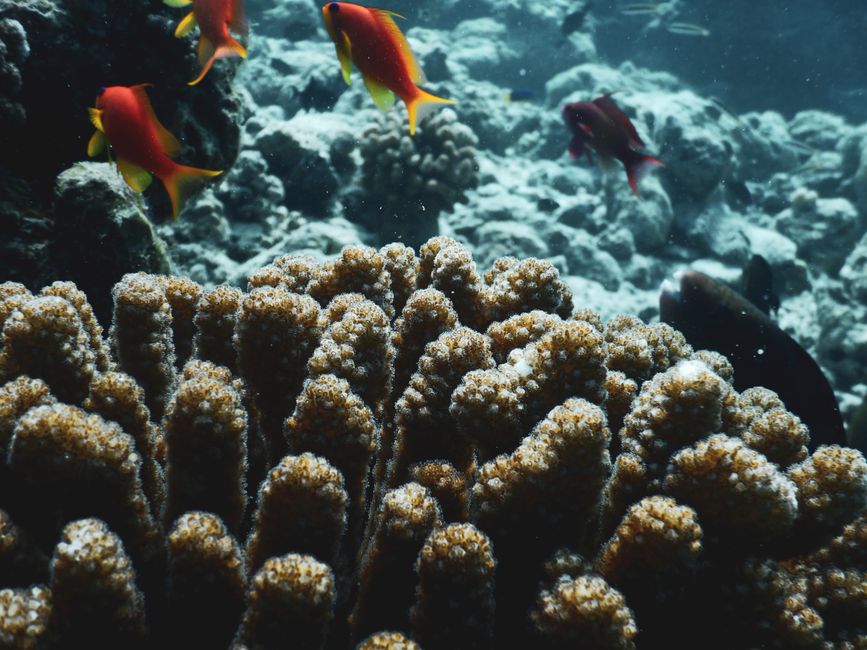
For snorkelers, this is about as good as it gets. The water temperature hovers between 27°C and 30°C (81–86°F) year-round, which means you can stay in the water for an hour without a wetsuit and never feel cold. The reefs begin in water shallow enough to stand in and then shelve off into vertical walls packed with hard corals, soft corals, and an almost cartoonish density of tropical fish. Because the islands are small and the resorts occupy single islands, the house reef — the coral reef directly off the beach — is often the single most important factor in choosing where to stay. A great house reef means you can walk out of your villa, pull on a mask, and be surrounded by reef sharks, turtles, and clouds of clownfish within five minutes.

But the Maldives is also one of the most expensive destinations on the planet, and the gap between a budget guesthouse trip and a luxury overwater-villa honeymoon is enormous. This guide answers the three questions we get asked more than any others: where are the best snorkeling spots and house reefs, what does a Maldives honeymoon really cost in 2026, and is January — the peak of the dry season — actually the best time to go?

---

## Maldives Snorkeling: The Complete Guide

### Why Maldives Snorkeling Is World-Class

The Maldives sits at the crossroads of the Indian Ocean, and its reefs benefit from two monsoon-driven currents that flush nutrients through the atoll channels. The result is a marine ecosystem that supports more than 2,000 species of fish, 200 species of coral, and a roster of megafauna — manta rays, whale sharks, reef sharks, and five of the world's seven sea turtle species — that very few snorkeling destinations can match. Unlike the Caribbean, where many reefs have suffered catastrophic coral bleaching, large sections of the Maldivian reef system remain in comparatively good health, and several atolls (notably Baa Atoll, a UNESCO World Biosphere Reserve) are actively protected.

What sets Maldives snorkeling apart from, say, the Great Barrier Reef or the Red Sea is accessibility. Because the islands are tiny and the reef fringes the shore, you do not need a boat to reach excellent snorkeling. A good house reef puts you over coral gardens and drop-offs within a few fin-kicks of the beach. When you do want to go further, boat trips to nearby thilas (submerged coral pinnacles) and kandus (channels) are short, cheap, and often included in resort packages. The water is warm, the visibility in the dry season regularly hits 20–30 metres, and the currents on the leeward sides of the atolls are gentle enough for confident beginners.

### What You Can See While Snorkeling

- **Manta rays** — The headline act. Baa Atoll's Hanifaru Bay is a feeding station where hundreds of mantas gather between May and November, but mantas can be seen year-round at cleaning stations like Lankan Manta Point (North Malé Atoll) and Manta Point at Ari Atoll. Wingspans reach 4–5 metres.
- **Whale sharks** — The world's largest fish, reaching 10 metres or more. South Ari Atoll is the most reliable spot, with sightings reported in every month of the year. January is a good month for whale sharks because the calm surface makes spotting them from the boat easy.
- **Sea turtles** — Green turtles and hawksbill turtles are common on house reefs, where they graze on seagrass and pick at sponges. Many resorts run dedicated "turtle tours" to known feeding sites.
- **Reef sharks** — Blacktip reef sharks patrol the shallows of almost every house reef in the country and are harmless to snorkelers. Whitetip reef sharks rest on the seabed in deeper channels. Grey reef sharks and hammerheads are seen on channel dives but less commonly from the surface.
- **Clownfish** — The Maldives has two endemic species (the Maldives anemonefish and the closely related Clark's anemonefish), and they are everywhere there is a sea anemone — which is almost everywhere.
- **Parrotfish** — The reef's most important maintenance crew. You will hear them crunching coral before you see them. Their colours — electric blue, green, pink — are some of the brightest on the reef.
- **Other regulars** — Butterflyfish, angelfi

[...]
Back to Blog | Back to Triprz