Destination of the Day: Barcelona, Spain
By Triprz Editorial Team | October 28, 2026
Barcelona pairs a Mediterranean beach with one of the densest concentrations of world-class architecture in Europe, all inside a walkable grid of shaded streets.
Tags: Barcelona, Spain, Destination of the Day, Travel Guide, 2026, hot, Southern Europe
Article
## Why Barcelona?

Barcelona is a city where Gothic stone meets Modernist concrete, where a 2,000-year-old Roman foundation supports one of the world's great food and design cultures. The capital of Catalonia sits on the Mediterranean coast, hemmed in by the Collserola hills and threaded with wide avenues laid out in a grid by 19th-century urban planner Ildefons Cerdà. That grid — the Eixample — is the skeleton that makes Barcelona one of Europe's most walkable major cities.

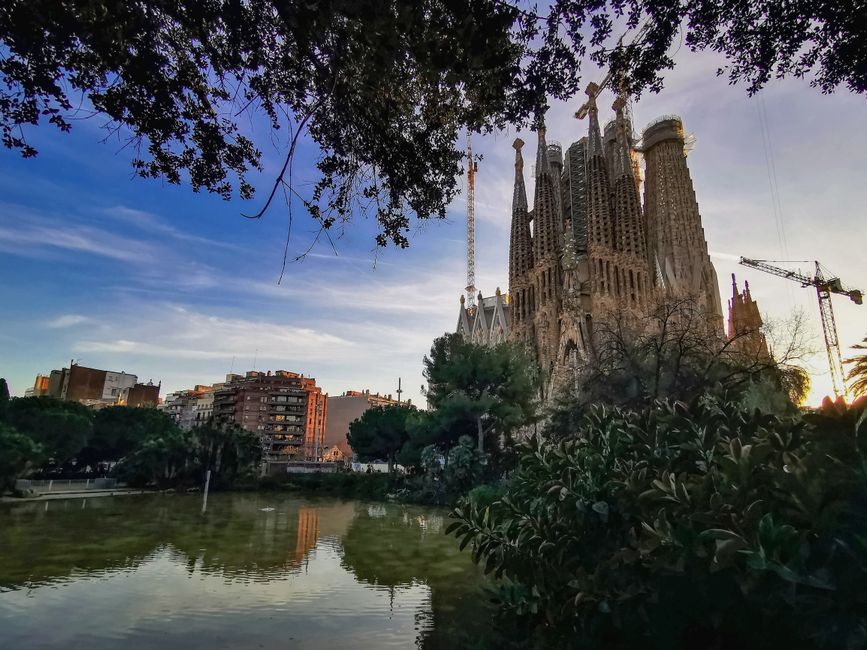
The tagline says it well: Barcelona is **Gaudí, tapas, and Mediterranean beaches**. Antoni Gaudí's fingerprints are everywhere — the Sagrada Família, Park Güell, Casa Batlló, and Casa Milà are all UNESCO World Heritage Sites, and the Sagrada Família remains the world's largest unfinished church, under construction since 1882 with a current target completion date of 2026. The food scene runs from vermouth on ice at a neighborhood bodega to multi-starred restaurants in the Eixample; Catalonia has produced some of Spain's most influential chefs, including Ferran Adrià and the Roca brothers. And the city's 4.2 km of beaches — imported sand and all — stretch from Barceloneta to the Forum, walkable from the Gothic Quarter in 15 minutes.

What makes Barcelona worth the trip is the **combination**. Few cities pack a medieval quarter, a world-class art scene, a Mediterranean coastline, and architecture that exists nowhere else into a single walkable core. The downside is the crowds: Barcelona received roughly 12 million overnight visitors in 2024, and the city has actively pushed back against overtourism with new short-term rental regulations and caps on tour group sizes. Visit in shoulder season, stay in a residential neighborhood, and you'll experience the Barcelona that locals fight to preserve.

**Rating: 4.7 / 5** — one of Europe's great city-break destinations, with a caveat about timing.

## Top 5 Things to Do

### 1. Visit the Sagrada Família

The [Sagrada Família](https://sagradafamilia.org/en/) is Gaudí's magnum opus and Barcelona's most iconic building. Started in 1882 and still under construction, it's expected to be completed by 2026 — the centenary of Gaudí's death. The interior is the highlight: tree-like columns branch into a ceiling that filters light through stained glass in forest-canopy greens and sunset oranges. Book timed-entry tickets well in advance at the official site — they sell out days ahead, especially in peak season. An adult basic ticket costs €36; tower access adds €10–15.

### 2. Wander the Gothic Quarter (Barri Gòtic)

The [Gothic Quarter](https://www.barcelonaturisme.com/wv3/en/page/745/the-gothic-quarter.html) is the oldest part of Barcelona, built on the ruins of the Roman settlement of Barcino. Narrow medieval streets open onto the Cathedral of Barcelona (Catedral de la Santa Creu i Santa Eulàlia, €9 entry), Plaça Reial with its Gaudí-designed lampposts, and Plaça Sant Jaume, the seat of Catalan government. The remains of the Roman wall are visible on Carrer del Bisbe and at the MUHBA (Barcelona History Museum). Budget half a day to get lost in the alleys — it's the most atmospheric part of the city.

### 3. Explore Park Güell and Gràcia

[Park Güell](https://www.barcelonaturisme.com/wv3/en/page/936/park-guell.html) is a public park designed by Gaudí between 1900 and 1914, originally conceived as a gated residential estate that failed commercially. The mosaic-covered serpentine bench on the main terrace offers panoramic views of the city, and the hypostyle hall with its Doric columns supports the terrace above. Entry to the monument zone is €10; the surrounding park is free. Afterward, walk into the Gràcia neighborhood — once an independent village, it retains a village feel with plazas, local shops, and fewer tourists than the Gothic Quarter.

### 4. Walk La Rambla and Visit La Boqueria Market

[La Rambla](https://www.barcelonaturisme.com/wv3/en/page/650/the-rambla.html) is Barcelona's most famous boulevard, a 1.2 km pedestrian street from Plaça de Catalunya to the waterfront. It's tourist-heavy but still worth a walk, especially in the early morning. Halfway down sits [Mercat de la Boqueria](https://www.boqueria.barcelona/), a covered market dating to 1217 in its original form. The food stalls sell everything from jamón ibérico to fresh juices to oysters. It's best visited before 11 a.m. to avoid the worst crowds. For a less touristy market alternative, try Mercat de Sant Antoni or Mercat de la Barceloneta.

### 5. Relax at Barceloneta Beach and the Waterfront

Barceloneta is Barcelona's beach neighborhood, a grid of narrow streets that was once a fishing village. The 4.2 km beachfront runs from the W Hotel to the Forum, with Barceloneta Beach the most popular section. The sand was imported from Egypt for the 1992 Olympics — before that, the coastline was industrial. Swim in summer (water reaches 25°C in August), eat at a beachfront chiringuito, or walk the promenade to Port Olímpic.

## When to Go

Barc

[...]
Back to Blog | Back to Triprz