Destination of the Day: Astana, Kazakhstan
By Triprz Editorial Team | October 17, 2026
Astana, renamed Nur-Sultan from 2019 to 2022, is Kazakhstan's purpose-built capital of futuristic skyscrapers, golden monuments, and steppeland extremes on the Ishim River.
Tags: Astana, Kazakhstan, Destination of the Day, Travel Guide, 2026, cold, Central Asia
Article
## Why Astana?

Astana is one of the strangest capital cities on earth. Until 1997 it was a provincial town called Akmola on the featureless steppe of northern Kazakhstan, known mainly for meat processing and a brutal winter that drops to -40 degrees. That year President Nursultan Nazarbayev moved the capital here from Almaty — partly to escape Almaty's earthquake risk, partly to anchor the restless Russian-speaking north — and poured billions into building a showpiece from scratch. The result is a city of wildly futuristic architecture, golden monuments, and broad boulevards rising out of the flat steppe like a mirage. (It was renamed Nur-Sultan in 2019 in honor of the outgoing president, then renamed back to Astana in 2022 — if you are confused, so is everyone.)

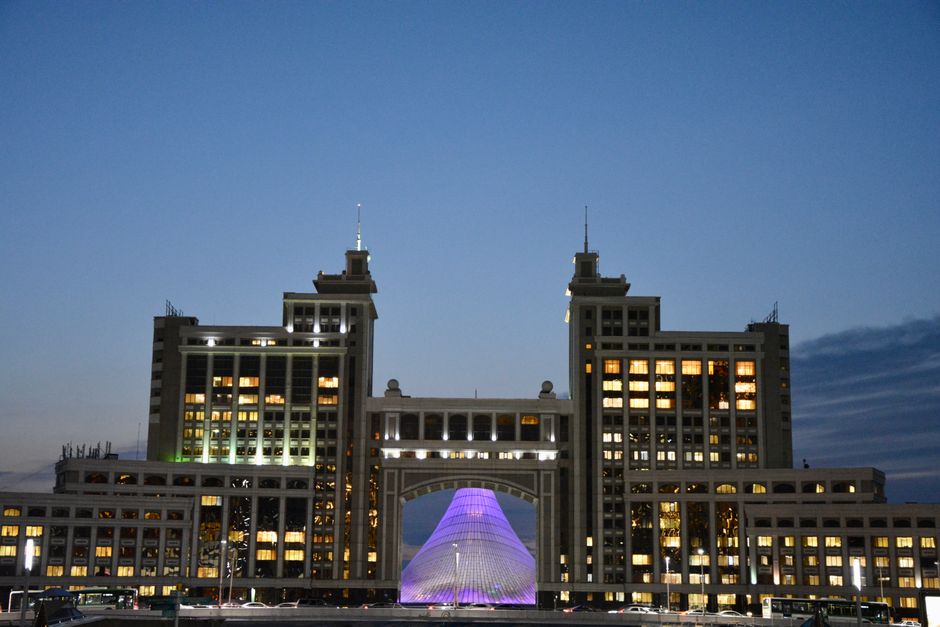
The architecture is the attraction. The left bank of the Ishim River, the new administrative center, is a parade of showpiece buildings: the Baiterek Tower (a 105-meter golden sphere on a latticed pillar, representing the mythical Samruk bird's egg), the Khan Shatyr Entertainment Center (a 150-meter translucent tent designed by Norman Foster that keeps the interior at 15 degrees while the steppe freezes outside), the Palace of Peace and Reconciliation (a glass pyramid, also by Foster, for interfaith dialogue), and the angular, mirrored ministries of Independence Square. At night the whole left bank lights up in a LED spectacle that turns the city into something approaching a science-fiction film set.

The right bank is older and more Soviet — the 1960s grid that predated the capital move — and it is here, in the markets and cafes, that you find the working city beneath the spectacle. Astana is also one of the coldest capitals in the world (second only to Ulaanbaatar), and the climate defines the experience: winter is genuinely dangerous if you are not dressed for it, while summer, though short, brings warm days (25–30 degrees) and a burst of cafe culture along the river. For architecture and geopolitics nerds it is unmissable; for those seeking traditional Silk Road atmosphere, the old capital Almaty or the towns of the south are better bets.

## Top 5 Things to Do

1. **Climb the Baiterek Tower** — This 105-meter tower with a golden sphere atop a latticed trunk is the symbol of Astana. An elevator takes you to an observation deck at 97 meters (the height references 1997, the year the capital moved) with panoramic views of the left bank. Inside the sphere you can place your hand in a gilded handprint said to be that of President Nazarbayev and make a wish. Best at sunset when the city lights begin to glow.

2. **Marvel at the Khan Shatyr Entertainment Center** — Designed by Norman Foster and opened in 2010, this 150-meter-tall translucent tent is a city-within-a-building — a beach resort (with sand imported from the Maldives), a shopping mall, a minigolf course, and indoor gardens all kept at a comfortable 15–30 degrees year-round regardless of the -35 or +35 outside. It is a surreal, spaceship-like structure and a marvel of climate engineering.

3. **Visit the Palace of Peace and Reconciliation** — Another Norman Foster design, this 62-meter glass pyramid hosts the Congress of Leaders of World and Traditional Religions and houses an opera hall for 1,500, a university, and a grand atrium. The pyramid is striking from outside and impressive inside — the top-floor "crèche of unity" offers a quiet, light-filled space. It sits at the apex of Independence Square, surrounded by the mirror-glass ministries.

4. **Explore the National Museum of the Republic of Kazakhstan** — Opened in 2014, this massive museum on Independence Square covers Kazakh history from the Bronze Age through nomadic culture, the Mongol era, the Russian and Soviet periods, and independence. Highlights include the Golden Hall (Saka gold from burial mounds, including the famous "Golden Man" warrior costume), a replica of the Kazakh yurt, and large-scale dioramas. Allow two to three hours.

5. **Walk the Nurzhol Boulevard and the riverfront** — The pedestrian spine of the left bank, Nurzhol (formerly "Green Water") Boulevard runs from the Baiterek Tower south through a sequence of parks, fountains, and reflecting pools past the key government buildings and the "Astana-Opera" theater. In summer it is full of families, cafes, and the Dancing Fountain light show; in winter it becomes a snowy, surreal promenade between the illuminated towers.

## When to Go

Astana has an extreme continental climate — the second-coldest capital in the world after Ulaanbaatar. Winter (November to March) is brutally cold, with temperatures regularly dropping to -30 to -40 degrees and a biting steppe wind; the river freezes solid. This is the time for the Khan Shatyr beach, ice fishing, and cross-country skiing, but not for casual sightseeing. Summer (June to August) is warm and pleasant (20–30 degrees), with long days and a burst of outdoor cafe culture. The shoulder months of May and September are cool but

[...]
Back to Blog | Back to Triprz